

Google & Bing know almost everything. Why only "almost"? With a market share of around 92%, Google is the top dog among search engines, with Bing trailing far behind in second place with around 3%, but still well ahead of other contenders. Both search engines automatically collect all your data and are the internet's homepage for about 95% of the world's population.
Everything that appears on the first pages there is visible on the internet and is clicked by users. Everything else is ignored. But even all the results collected by Google & Co. are not complete. The percentage of the internet not indexed by search engines is not known. Furthermore, it is quite easy to hide a website from Google & Co.
What is the Deep Web?
Everything that is not captured by search engines is called the "Deep Web". And then there is a specially encrypted area on the net, the so-called Darknet. This, by the way, is not exclusively used for illegal purposes. Technically, the Darknet is therefore part of the Deep Web. It is also sometimes referred to as the "Hidden Web", and sometimes the words Darknet and Deep Web are simply used synonymously.
So: The Deep Web includes all areas of the internet that are not indexed by conventional search engines like Google or Bing. This includes, for example, password-protected areas, private databases, and internal networks. The Darknet is a part of the Deep Web specifically designed for anonymity. It is only accessible via special software such as the Tor browser and allows access to so-called .onion websites, which are not accessible via normal browsers.
Is the Darknet forbidden?
No, the Darknet is not forbidden. On the contrary: The Darknet is one of the last bastions of free speech; the network is therefore also used worldwide by journalists, human rights organizations, critics of regimes, and oppressed minorities. And unfortunately, it is also a breeding ground for criminals.
The Darknet is a network without censorship and surveillance – with all its advantages and disadvantages. For example, some newspapers like the New York Times have set up their own pages in the Darknet so that informants can anonymously transmit confidential information.
Well-known IT journalists like Mike Tigas, by the way, have their own homepage in the Darknet – which also exists "in the normal" internet.
What and where is the Darknet?
How do I get into the Darknet? Is the Darknet forbidden? – These are probably the usual questions in connection with this part of the internet. The Darknet relies on the same parts of the internet that all other internet services use: websites, email, and file sharing. All of this, just like the rest of the internet, is freely available – you just need to know how to get there and where to look.
Anyone who wants to surf in the Darknet first needs anonymous access to the Tor network. Tor is originally an abbreviation for "The Onion Router" and is a network for anonymizing connection data, which has existed since around 2002 and was largely developed by students at the University of Cambridge. You will read the word "Onion" several more times in the following article, by the way.
The word Onion refers to the different layers that data must penetrate on its way from the user to the website: a whole series of servers is always involved in the respective connection between user and server to ensure the greatest possible anonymity. Currently, about 2 million people use the Tor network every day.
Regarding the technical background of the Tor network: If someone searches on the "normal" internet, e.g., on Google, their IP address is directly connected to Google. In the Tor network, there are at least three more servers (so-called nodes) between one's own IP and the website to be visited, and therefore it is not possible to trace where the visitor comes from. The source code on which the Darknet is based is, by the way, Open Source and viewable by anyone. Anyone who wants to can also actively participate and provide their own server, which then acts as an anonymous node in the Darkweb or in the Tor network. It is of course also possible to put your own pages into the Darknet.
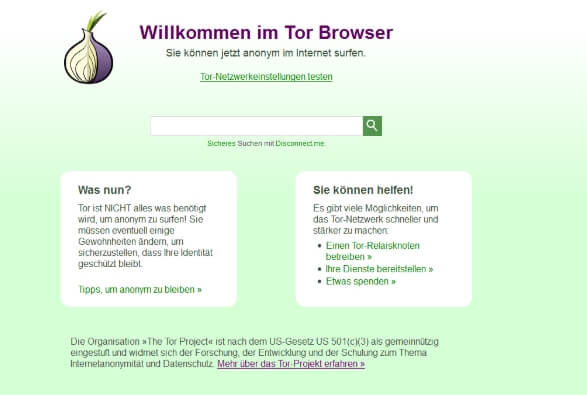
What is a Tor Browser?
The Tor Browser is a special version of Firefox that automatically selects the Tor network as an access point to the internet. The Tor Browser is also included in our Windows-compatible software Cyber Shield!
Solutions for Darknet browsers are also available for download for other operating systems and your mobile phone, e.g., "Tor Browser" for MacOS, "Onion Browser" for iPhone & iPad, and Orfox, Orbot, or "Tor Browser" – all for Android. Users of an Android device probably have the largest selection.
A free version of the Tor Browser, including for Windows, is available for download on the Tor Project website: https://www.torproject.org/projects/torbrowser.html.en
Although the Tor Browser offers anonymity, using VPN software, i.e., a VPN (Virtual Private Network), can add an additional layer of security by obscuring your IP address.
Darknet: Please be careful!
As everywhere in life, one should also approach the Darknet with a healthy dose of skepticism. Where no censorship or surveillance is possible, there are also a lot of shady characters. But there are not only marketplaces for drug trafficking or arms deals! Visiting Darknet shopping malls might not be the best idea.
You should also not disclose your personal data anywhere and not upload self-created pictures & videos anywhere. Downloads from the Darknet are potentially dangerous, and you should simply not buy anything in the Darknet. Do yourself that favor.
When surfing, simply believe and trust no one in the Darknet! Remember: The other users are also anonymous! Sometimes it is even advised to cover your webcam when you are in the Darknet. However, that might be a bit too paranoid.
We hope we haven't scared you now? But a little caution, especially when surfing in the Darknet, can't hurt!
Guide to the Darknet
In the Darknet, there are no usual domains with endings like .de, .com, or similar. The ending used in the Darknet is .onion
- The most popular site in the Darkweb is probably the Onion version of Facebook. Through this site, Facebook can be used anonymously without fear of tracking. This service is also the only option for people from countries like China, Iran, or some African states where Facebook is censored and blocked. The address is: https://www.facebookcorewwwi.onion/
Many websites in the Darknet do not stay online for very long. That's why there are search engines and more or less up-to-date link lists in the Darknet – just like in the rest of the internet.
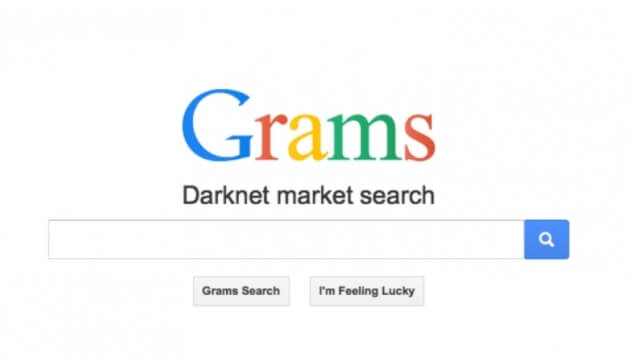
For a long time, the dominant search engine in the Darknet was Grams. It was essentially the Google of the Darknet. With Grams, it was possible to search the Darknet – and it also looked quite similar. However, Grams didn't actively search the Darknet on its own; a website always had to be registered with Grams first. But Grams has disappeared from the scene for several months now.
- A current alternative is Torch. Torch's current address is http://xmh57jrzrnw6insl.onion
- Wiki Links (http://wikilink77h7lrbi.onion/), Deep Weblinks (http://deepppr5ooheo7n6.onion/), OnionDir, Tor Links or Hidden Wiki (http://zqktlwi4fecvo6ri.onion) are typical link directories, with all their advantages and disadvantages.
And don't be surprised: The websites and link portals in the Darknet are reminiscent of websites from the 90s of the last millennium. So, a nostalgic mood can easily arise in the Darknet. 😊
- Of course, there is also email in the Darknet! One provider is, for example, TorBox, where you can set up an anonymous account for free. However, you can only send and receive emails within the Darknet. The service can be reached at the address http://torbox3uiot6wchz.onion/
- If you want to perform money transfers in the Darknet, you have to look for services like OnionWallet. OnionWallet & Co. act similarly to PayPal and resemble a digital wallet. The link to the piggy bank for Bitcoins is http://aewfdl3tyohbcenp.onion/
- An alternative is, for example, EasyCoin, which is also available in German: http://ts4cwattzgsiitv7.onion/
Safety tips for accessing the Darknet
- Do not disclose personal information: Avoid entering personal data on Darknet websites.
- Caution with downloads: Do not download files from unknown or untrustworthy sources.
- Regular updates: Keep the Tor browser and your operating system up to date to avoid security vulnerabilities.
Conclusion
Access to the Darknet requires special software and precautions, but also offers opportunities for anonymous surfing and access to uncensored information. It is important to be aware of the risks and to use the freedoms offered responsibly.
We wish you much fun on your journey of discovery into the Darknet. But it cannot be said often enough: Be careful!


