

Turning 40 this year: We would like to congratulate the Sony Walkman on its milestone birthday. In 1979, Sony's Walkman was launched as a portable, battery-powered cassette player and quickly achieved cult status. Closely associated with the portable Sony Walkman is the music cassette, which also enjoys cult status.
Cassette and Walkman (including headphones) formed an unbeatable team for over two decades and probably shaped the youth and lifestyle of everyone who was a teenager and listened to music sometime between 1979 and 1999. Many at the time couldn't imagine life without a Walkman and cassettes. MP3 players, iPods, USB sticks, Bluetooth, or online music-sharing platforms on the internet had not yet been invented. The cloud did not exist.
Thus, before CD-ROMs, Mini-Discs, USB sticks, SD cards, cell phones, smartphones, and hard drives, the audio cassette was the dominant storage medium for music. And to listen to audio cassettes, you would insert them into a player. Storing or transferring music to cassette was terribly complicated and time-consuming. If you didn't want to record music from the radio, a cassette player with two decks was needed for this. One for playback, the other was the recorder. A device whose delivery was sometimes only possible in limited quantities.
Low Data Volume for Cassettes
It started with the data volume: The capacity, i.e., the storage of a conventional stereo audio cassette, was only 60 min, 90 min, or a maximum of 120 minutes (plus usually a few minutes tolerance). This corresponds to approx. 18, 24, or 30 songs per cassette. The price, depending on the brand and offer, ranged between 2 and 5 DM.
To save recordings, songs had to be painstakingly gathered. It was usually advisable to think in advance about what you wanted to have on the audio cassette. The transfer to the cassette's magnetic tape then took place in real-time. Errors in the arrangement or selection of music tracks meant that the entire work had to be done again – in the worst case, from the beginning. And with every saving process or further copy, a bit of sound quality was lost. A copy of a copy was already of insufficient quality – even on the best cassette player or the best Walkman. High-quality sound was usually only offered by new cassettes that were recorded once, or purchased cassettes. High-resolution audio for copies simply did not exist in this form.
Thus, with the advent of CD burners from the mid-90s, the cassette was successively replaced by the CD, and from the late 90s, by the MP3. In 1998, the first portable MP3 players joined the Walkman (by then there were several models and new brands of Walkman) in electronics stores – and from then on, everything moved very quickly.
The fact that cassettes and PCs do not combine well is probably a decisive reason why this once proud and widespread medium has almost completely disappeared from the shelves of all supermarkets and electronics stores. Sony and Maxell, for example, still produce cassettes today – in 2023. Finding other manufacturers becomes difficult. And with the cassettes, the Walkman also disappeared.
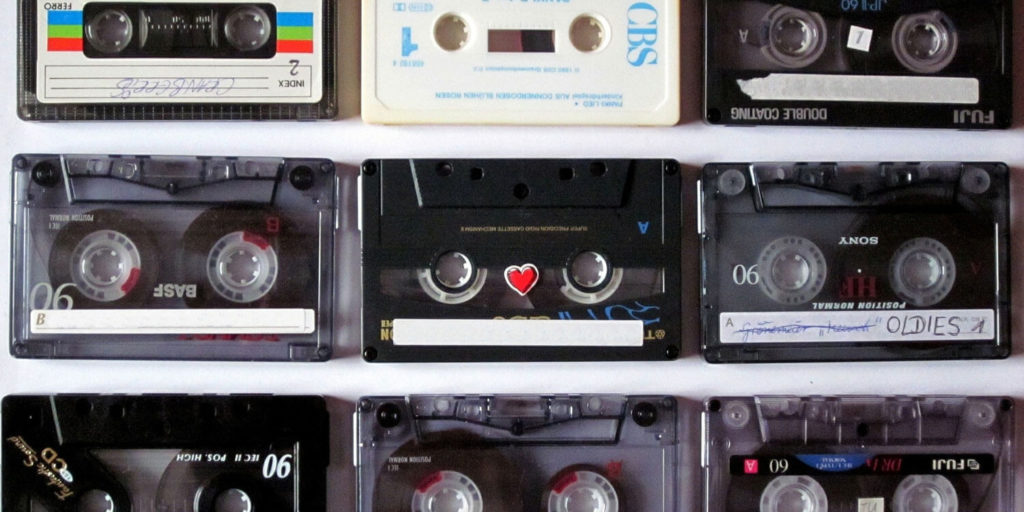
Today, we store music almost exclusively digitally. Cassettes (or records) and the Walkman (no matter which model) have become something for enthusiasts. More data on a smaller medium, lightning-fast compilation of different and any number of playlists, and no loss of quality when copying songs: The digitization of music has many advantages.
Digital Copy Protection
The only downside: Unlike cassettes, digital music files can be equipped with a copy protection function (DRM protection). Owners of a song with DRM protection – even if they legally purchased it from, for example, iTunes or musicload – are then unable to copy their song to another portable player (MP3 player, iPod, Apple or Android smartphone, USB stick, etc.) or convert the data format. A very annoying measure by the music industry, and many were frustrated trying to circumvent the copy protection and transfer the content, seeing red and feeling blue.
But even that was not a reason for most users to switch back to the Walkman and cassette. With freeTunes , for example, a long-successful software, this annoying DRM protection can be circumvented completely legally – and the files are converted into another format (MP3, AAC, OGG, WMA or WAV) if desired – lightning fast, all in series and with a few clicks. Only those who still want to transfer their songs from the PC to a classic music cassette for their Walkman – be it out of nostalgia or for the 40th birthday – still have to resort to a "storage method" that still only works in real-time.


