

At what age should children be allowed to play PC games and video games? This is a question that has long divided opinions and generations. Mark Zuckerberg, multi-billionaire and Facebook founder, once said that without video games, there would be no Facebook today – because games on PC and console and the desire to create his own games were the real reason he started programming and experimenting with code and algorithms.
The same may apply to Apple and Tesla, as both Apple founder Steve Jobs and Tesla CEO Elon Musk programmed games on their PCs in their childhood – and acquired much of the know-how that is now embedded in their companies. Programming video games in childhood therefore increases the chance of founding a multi-billion dollar IT company oneself – and if that is too ambitious, it is at least a good prerequisite for a good job in the age of the digital revolution. In this article, we want to give some suggestions for game programming.
Frameworks and game engines instead of programming video games with Basic and C64
In the past, programming knowledge and programming languages (e.g., C++ or Java / Javascript) were indispensable for programming a game. Today, this is no longer a prerequisite, as there are modern programs, game engines, and frameworks that help in creating games. Here, the necessary "ingredients" such as effects, animations, language, physics, sound, controls, time, etc. do not have to be programmed in the game or a development environment, but can simply be selected, integrated, and combined as tools.
The following game engines, tools, and frameworks for computer games are well suited for beginners with little programming experience:
For advanced users and programmers, these game engines are recommended, among others:
And for children and young people, we recommend the tool Scratch
Scratch is a visual programming language and attempts to convey programming knowledge in a playful way – e.g., by creating small games and multimedia applications.
To get started with this program right away, most sites offer simple tutorials or easy-to-understand step-by-step instructions to quickly familiarize yourself with functions, framework, and engine.
A good game idea doesn't have to be complex to program
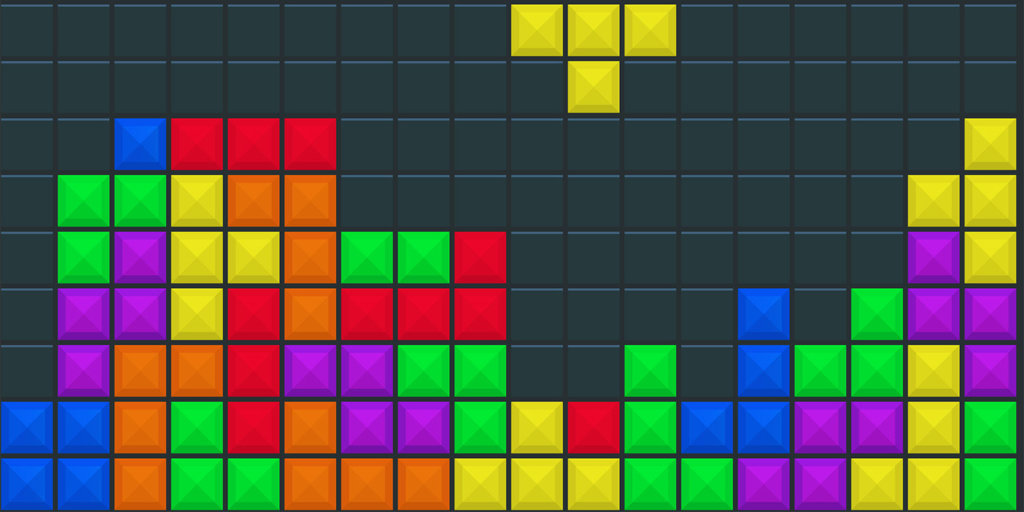
Video games that are fun don't necessarily have to be very time-consuming and difficult to design or program. Tetris, for example, was such an "easy-to-develop" century-old idea. Today, the game is one of the most successful video games of all time – and in terms of units sold, it is far ahead of triple-A titles like Super Mario, GTA, or Grand Theft Auto. Tetris was programmed in 1984 by a single developer – Alexey Pajitnov – as a hobby – without a million-dollar budget and without an expensive marketing campaign surrounding it. Even great effects and 3D graphics are no guarantee for successful games. As seen in the Tetris example, 2D can also be completely convincing.
Programming video games while observing copyright and licensing rights
There is nothing wrong with rebuilding known or existing games for practice purposes. Only if you are seriously considering publishing or marketing your own game (this would be possible, for example, on Steam, the App Store, Google Play, etc.) should you consider copyright and license rights. Music or characters from other games are logically taboo. It is also taboo with most engines to create games for commercial purposes and then sell them. If this is the goal of your game development, you usually have to buy the somewhat more expensive licenses. The same applies, of course, to the use of tracks and image material.
Thoroughly test self-developed video games
In your first version, did you consider all the central elements, such as:
- a suitable background and suitable music?
- a (small) plot?
- controls and simple operation?
- a system for collecting points in the game?
- ways to win or lose?
- different levels
- a tutorial or several small tutorials for players to learn the game
- your own video that provides assistance and information to the player
Then test your game thoroughly - step by step. Also, let friends and acquaintances try out your project. Listen to their feedback and possibly incorporate new ideas. Small errors are often overlooked.
To avoid giving you false hope at this point: You probably haven't developed a milestone in the gaming world – but then neither did Steve Jobs, Elon Musk, and Mark Zuckerberg. Much more valuable than this, however, is the programming experience and knowledge in handling source code that you gain from this work. And who knows, maybe the development of your game will be the foundation for another ingenious invention…


