

A TV with 4k resolution? These days, that barely elicits a tired smile from some. The world of electronics and gadgets seems to offer almost no sensations in some areas. Even though there will certainly be many further developments, we have already come a long way compared to the year 2000.
The situation is quite different in the smart home sector: here, we can expect innovations in the near future that will certainly delight many and make our lives easier. Smart Home has long been a firm fixture at CES in Las Vegas (CES website: https://www.ces.tech). And in the coming years, this topic is guaranteed to overtake several other areas of consumer electronics.
Smart Home: Glitches are part of the game
As in all areas that involve big data, data breaches can never be completely ruled out in the still-young smart home playing field. Of course, this is a bit embarrassing for the respective provider.
Rule of thumb: the larger or more controversial the corporation, the greater the schadenfreude. Even in individual cases. Like recently, when an Amazon customer simply wanted to inquire what data the trading platform had stored about him. It’s quite simple:
For example, by following this link (https://www.amazon.de/hz/mycd/myx/#/home/alexaPrivacy/home), you can directly retrieve everything your Alexa has recorded.
In the case mentioned here, the user simply wanted to generally check what Amazon had stored about him. And promptly he received a data package with Alexa voice input. The only problem: This user had never used Alexa before that day. A real smart home newbie. So the data came from someone else. Uh oh…
A consumer profile is created in no time
An unfortunate isolated incident, as Amazon was able to credibly claim afterwards. But still a nice example of how Big Data and our privacy in the cloud are increasingly merging. Of course, some will immediately argue: "Hey, I have nothing to hide!"
That may be true – and yet it could lead to at least tiny distortions in your own consumer profile if your 16-year-old offspring occasionally searches for absurd products with other curious peers unsupervised… Just curiosity 🙂. Well, that might create interesting profiles of people who prefer organic products, psychological family guides, erotic lingerie, and over-the-counter weapons. Any more questions?
You can delete Alexa recordings yourself
So, every now and then, it seems quite useful, even at the beginning of Smart Home applications, to check your own data on all possible platforms and, if necessary, simply delete it. Like the voice input for Alexa. Because that's possible: and also under this link to Amazon (https://www.amazon.de/hz/mycd/myx/#/home/alexaPrivacy/home).
By the way, Amazon is expressly NOT to be pilloried here! This example merely serves to illustrate what gets stuck between real life and the cloud.
And it will – one doesn't have to be a clairvoyant – store much more in the future. Smart Home, if one wants to describe it vividly, is still in its infancy. A case primarily for the upper ten thousand who want to control their alarm system in their own villa via app? Not at all!
In a few years, it will be completely normal for a large part of the population in our industrial nations worldwide to control objects by voice command or with a smartphone: from multi-room hi-fi to household appliances to roller shutter control.
With Smart Home, many more applications are coming – with and without Alexa
And these applications will learn quite quickly. Monday, Wednesday, and Thursday the blackout goes on at 8 p.m., Tuesday always only at 10 p.m., and the rest of the week already at 7 p.m.? After a month, the control system will gladly take over automatically. Let's be honest: wouldn't you, as a burglar, rather hack into the system, arrange a visit for Tuesday around 7:30 p.m., and look around undisturbed?
Where cloud-based technology works, people will always be keen to exploit it for their own interests. This is exactly how the optimization of advertisements in the internet browser works, to enable us – as it is nicely put – an optimally personalized experience. Of course, it's just about marketing. And some people even think that's great.

Internet of Things – in the Smart Home of the future, everything communicates with everything
Of course, there will be many people who find it pleasant when the coffee machine, connected to the Internet of Things, sends a short ping to their smartphone in the future asking if it should order 100 new coffee capsules. And many will go into raptures when the refrigerator immediately after notes that they probably also need milk. So cool! Eventually, it will be quite normal for our kitchen appliances to have simply calculated, based on algorithms, that there is a parallel in our household between coffee and milk consumption. Latte macchiato, that is.
And finally, in our smart home, it will also be normal when the alarm clock reminds us on Monday morning, dutifully raises the blinds at 7 a.m., starts our favorite playlist from the streaming service, and probably even prepares a delicious milk coffee. While we no longer have to worry about not having set this alarm clock at all.
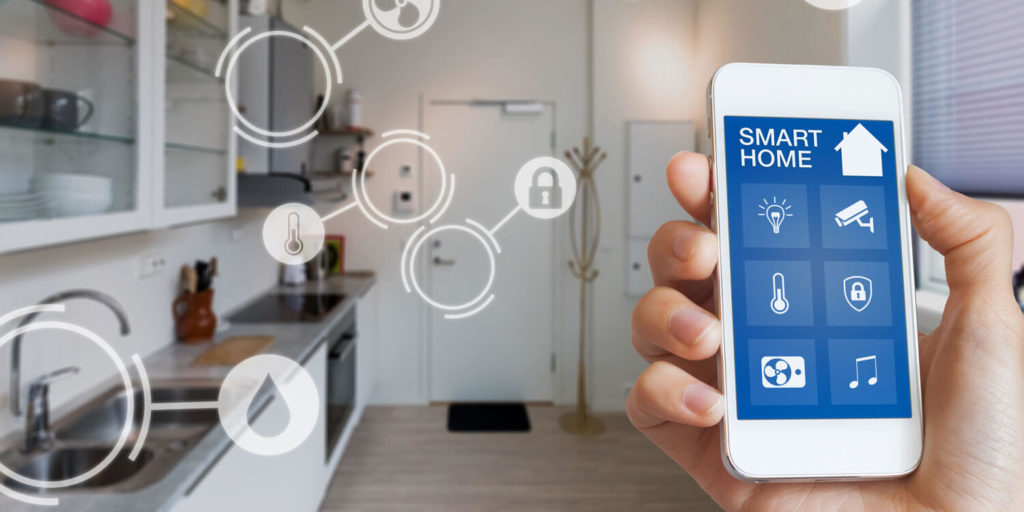
Data deletion on demand? Why not!
And if, in addition to coffee and milk, the question also arises whether you'd like to add vodka and edible thongs to your shopping list? It's probably time to have an informative chat with the offspring. And perhaps also to clean up all the data clutter that has accumulated in the cloud. But even that will certainly soon be possible on demand – as it should be in a sensible smart home.


