

How warm is it outside right now? Is Legoland (or another facility) open yet? Can I hear my favorite song one more time? These are questions and wishes that children and toddlers express daily. It's very convenient to have a digital voice assistant like Alexa, Siri, or Cortana in the household, which can answer these questions directly for parents and children. But are these voice assistants only a tool for parents, who don't always know everything themselves? Or can Alexa and Co. be safely placed in a child's room? Here are some background information and arguments.
How long have voice assistants existed?
If we skip the history of voice assistants, whose beginnings go back to Thomas Edison (keyword Ediphone / mechanical dictating machine) and the year 1877 (!), Siri is considered the first modern digital voice assistant. Developed since 2007 and bought by Apple in 2010, Siri first appeared on the iPhone 4 in 2011. Today, Siri is an essential part of all Apple products. Alexa (or Amazon Echo), Amazon's voice assistant, whose name is often used synonymously with digital voice assistants, has only existed since 2015. Today, digital voice assistants are also available as an app. They are an integral part of the digital home (keyword smart home), and the price of these technical helpers is also getting smaller.
Which voice assistants are there?
In addition to the already mentioned Siri (Speech Interpretation and Recognition Interface) from Apple and Alexa from Amazon (the product is actually called Amazon Echo, Alexa is just the activation word), there are also the following notable competitors:
- Google Assistant, from Google, developed for Android, Google Home, iOS and the messenger Google Allo
- Cortana, from Microsoft and an essential component of Windows 10 (also Windows 11 after manual activation).
- Bixby, Samsung's voice assistant for Samsung devices
- Hallo Magenta, an intelligent, internet-based speaker from Deutsche Telekom
- Other Amazon voice assistants, such as Amazon Echo (Echo Flex, Echo Dot, Echo Show). Amazon Echo is already in its third generation (3rd Gen). Every Echo device, or all Echo devices, are small, smart, and can all be activated with the same word: Alexa
How do Alexa and Co. work?
Alexa or Amazon Echo is an intelligent speaker. All Echo devices are connected via the internet to an intelligent voice software based on AI. This software accesses all information and data available on the internet, as well as its own services or data and services from other providers. This access to countless pieces of information makes the voice assistant so helpful and smart, as the device can answer almost any question for your child in real-time, drawing on an infinitely large database of content. If you want a song, specific music, or an audio play for your child/children, for example, Amazon Echo will find it and play it for you.
The devices are designed so that you always have to say an activation word before they respond to you and your question. Without this precaution, the voice assistant would probably constantly chime in. When you activate your device, you'll recognize it by the blue color of a light ring – or on devices of a higher generation (Gen), you'll also see it on the display.
The most well-known activation word for Amazon Echo / Amazon Echo Dot is "Alexa" (alternative options include "Amazon" or "Computer"). Only then does it interact with the owners, record conversations, and send the data to the cloud for processing. Alexa is now so well-known that Amazon's digital assistants are also called Amazon Alexa. Of course, there's also an Alexa app for mobile use when you and your children are not at home.
In addition, Amazon Echo – like all other digital voice assistants – is AI-supported and intelligent, and programmed to continuously learn. Alexa recognizes when you are satisfied or dissatisfied with a search result; for example, when you have to ask multiple times or clarify your question. The AI also learns from the things you or your children ask or say. The goal is – in addition to collecting as much personal data as possible – to optimize Alexa so that you and your children get exactly the answer from Alexa you need for every question. This function is the basic principle and similar for all voice assistants.
Should Alexa be in the children's room?
You have an intelligent, virtual person who answers every question correctly for your child, fulfills every wish (at least every musical wish) for your child, and all of this for free and around the clock? It's understandable that stressed parents sometimes want to place this device in their kids' room. Parents themselves know that this is not necessarily responsible. But as always in life, the same applies here: you have to be able to differentiate.
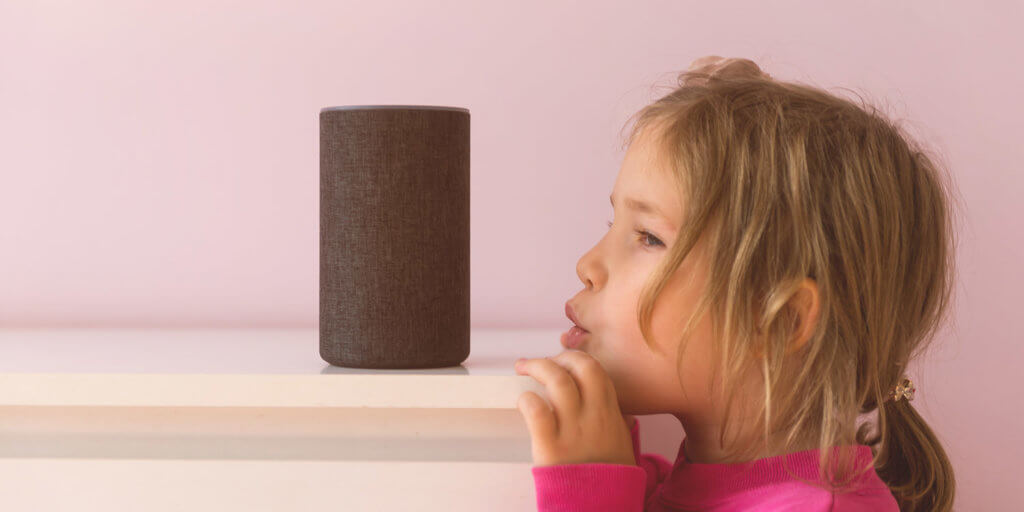
Completely safe: Integrating Alexa into everyday life
Even though most parents today grew up relatively analog – with football in the yard, tangible books, Lego and Ludo, as well as other small games in bad weather, and TV programming that was time-dependent – the trend towards increasing digitalization cannot be reversed. And preparing children responsibly and smartly for the digital world, including its opportunities and risks, is a must today.
So why not integrate Alexa (or the Alexa app) or another intelligent voice assistant into everyday life? As long as everything happens under the supervision or within earshot of the parents – and your children handle the digital assistant responsibly – this is completely harmless.
Age and maturity play an important role
We already spoke of children and toddlers in the introduction. The age range of those we are talking about here therefore extends from one year and one day (a toddler is defined as beginning from the 2nd year until the completion of the 3rd year of life) to one day before the thirteenth birthday (definition of child: from the beginning of the 4th to the completion of the 12th year of life). It is absolutely clear that age must be taken into account when practically dealing with and setting rules for Alexa and Co. Certainly, the mental maturity and technical skills of the children must also be considered. The older and more mature, the more frequent and independent the use of digital intelligent voice assistants can and should be. But should the device therefore go straight into the children's room, where your kids use Alexa unsupervised? A clear no!
Inappropriate and paid content, insufficient protection measures
Alexa plays songs, music, audiobooks, and audio plays. It knows fairy tales, games, tells jokes, reads bedtime stories, and can also teach children interactively and with a lot of fun through quiz and guessing games.
However, it also offers children access to inappropriate and paid content. Unfortunately, the protective measures and the option to make the device somewhat safer for children in the settings are insufficient. There is no explicit parental control or reliable youth protection setting. And so, even the scientific service of the Bundestag warns about the risks for minors.
Very illustrative and somehow funny is the video of a six-year-old who wants a children's song and shouts "play Digger Digger" into the microphone. But what does Alexa suggest? Answer: The titles of porn. Fortunately, the parents can intervene in time. There are many stories and mishaps like this.
In addition, Alexia is directly connected to the Amazon account – thus enabling convenient shopping by voice. If you're not careful for a moment, the offspring has not only found out about the latest toys, but has also ordered the best ones immediately. Although voice purchasing can be deactivated in the settings, this is one of the few ways to make Alexa somewhat child-safe.
Data collection: Conversations from the children's room end up with Amazon via Alexa
It has long been known that digital voice assistants collect data. Officially, of course, to improve the software. Naysayers claim that these functions of digital voice assistants work best. But what else happens with the data – and by data, we mean recorded conversations at this point – no one knows. In dealing with Alexa and Co., it has been shown that children, in particular, are much less hesitant to share personal and sensitive information with the voice assistant. Children's room conversations then end up with Amazon's analysts. Although there are ways and means to review and even delete the voice recording history, only Amazon knows whether this data is actually completely deleted or just set to "inactive."
The issue of data protection is, of course, also problematic in this context. While you have agreed to Amazon's terms and conditions when installing Amazon Echo, your visitors and the parents of other children who come to play have not. Under certain circumstances, your visitor may not even notice that Alexa is present and recording everything the children say. Data protection is violated here.
Conclusion: Better to wait until 18
As shown, digital voice assistants can enormously simplify everyday family life. There is great and pedagogically valuable content for children, with which they can also occupy themselves for longer periods. Children also learn how to use modern technical devices and their functions, and develop media literacy and digital competence. Two important skills in our modern world.
Nevertheless, Alexa should not be in the children's room – no matter how sensible or mature the child may be. Because the gate to all the unsavory – or at least inappropriate for children – content waiting on the internet can only be partially closed. Not all functions can be set in such a way that these possibilities are excluded for children. Amazon itself has recognized this and recommends in its privacy policy that young people under 18 should only use Amazon's voice-based services accompanied by a parent or guardian.


