

Fake offers, collection scam, triangulation fraud: The list of scam methods on Ebay Kleinanzeigen is long. In this blog post, we'll show you how the most common scams work and what users on Ebay Kleinanzeigen should look out for to avoid becoming victims of fraud.
Note: Since the scam methods shown below only work on Ebay Kleinanzeigen, but not on Ebay, we will start the article with a brief comparison of Ebay and Ebay Kleinanzeigen. If you already know the differences, just scroll down a bit.
Ebay is not Ebay Kleinanzeigen
Ebay Kleinanzeigen is not Ebay. Although both platforms feature the colorful, four-color Ebay logo, beyond that, the two platforms have little in common, even though ads, items, buying, and selling play a central role on each platform.
Ebay vs. Kleinanzeigen: The Company
Ebay belongs to the US company Ebay Inc. based in California. Ebay Kleinanzeigen belongs to Adevinta, a publicly traded group from Norway. Kleinanzeigen was sold by Ebay Inc. to Adevinta only in 2021, and Ebay still holds a significant share of Adevinta's shares and one third of the voting rights; however, two different companies are responsible for the platforms.
The Rules of the Game
More crucial than the question of who owns what are the rules of the game and the philosophy of both platforms. And these could not be more different.
Security at the Expense of Flexibility on Ebay
Ebay, for example, has defined rules of the game for all conceivable scenarios and situations that can exist between buyers and sellers on the internet and has programmed a "function in a drop-down menu" for this. Buying and selling does not take place through direct communication, but predominantly through clicks and bids. Almost everything has been considered: Whether it's price suggestions, requests for bundling and minimizing shipping costs (if you ordered more from the same seller) to returns if you are dissatisfied with the goods – there are functions for everything, and most of it is then automated according to a firmly defined process.
This makes Ebay inflexible for some, as buyers and sellers can only interact to the extent that Ebay has provided and programmed it. However, it offers buyers and sellers maximum security against fraud and rip-offs. Recently, buyers no longer transfer money for paid goods to the seller, but directly to Ebay. And Ebay only transfers the money to the seller once the buyer has received the goods from the listing and is satisfied with them (i.e., if they don't complain). And since the processing of registered and insured package shipping also takes place via Ebay, or can take place, Ebay always knows when the goods were delivered and whether a transaction was successful. Only then does the seller receive their money – minus a fee. It can hardly be made safer.
Flexibility at the Expense of Security on Ebay Kleinanzeigen
Ebay Kleinanzeigen works differently. Buyers and sellers on Kleinanzeigen have to "talk" to each other online about the ad and handle the transaction themselves in the Ebay Kleinanzeigen chat. Here, they agree on the price for an item or an ad, shipping costs, possible discounts (if more than one item is ordered from the same person), and how goods and money are to be handed over/transferred. Bank and account details and address data (including cell phone numbers) are exchanged in the chat (on Ebay, these are stored systematically, securely, and verified). Transfers on Kleinanzeigen must be carried out independently (on Ebay, this works with just a few clicks thanks to Paypal). And shipping (stamp, address) must be organized independently on Kleinanzeigen (on Ebay, shipping labels including stamp and address are ready to print as a PDF with just a few clicks). Only the sold goods themselves have to be packed and taken to the shipping provider on both platforms.
However, it is precisely this process, where buyers and sellers – who do not necessarily meet in person during their transaction – trade with each other without rules and monitoring by a third party, that opens the door to fraudsters. Fraudsters have already come up with many brazen and creative schemes. We will present three of them in more detail below and show how to protect yourself against them.
Fraud on Ebay Kleinanzeigen: Three Popular Scams Used by Fraudsters
1. Fake Offers
In this example, the buyer is the victim and the seller is the perpetrator.
How the "Fake Offer" Scam Works on Ebay Kleinanzeigen:
Most sellers on Ebay Kleinanzeigen are honest. And users who have good experiences over the years eventually become trusting. Fraudsters exploit this by offering goods they don't even have or don't want to give away. The buyer pays to buy something but receives no goods. Eventually, communication ends, and the "seller" is no longer traceable. Even though almost everyone is probably familiar with this criminal scheme, it still exists, and enough trusting buyers still fall for fake offers.
How to Recognize Fake Offers:
How convincing fake offers ultimately are depends on the time and effort a scammer puts into creating their fake offers. You should be suspicious of the following points:
- The offer and other offers from the seller are significantly cheaper than the average. This means: Someone here wants to sell quickly rather than necessarily get a good price.
- The offers only consist of highly sought-after items where fraud is worthwhile (no small items under 10 euros), usually things that cost two to three digits (cell phones, cameras, expensive toys, etc.).
- The seller's account is relatively new – and the seller has few to no reviews.
- If you contact the seller, they will find reasons why you cannot pick up the goods in person and pay cash.
- For the transfer, the seller wants PayPal in the "Friends and Family" option to save on fees. They will not accept alternatives.
How to Protect Yourself from This Fraud on Ebay Kleinanzeigen:
The more of the above points that apply, the more likely it is a fake offer that is not genuine. Therefore, offer the seller payment via Paypal with buyer protection (Goods and Services option). This will probably cost you a little more, but it is safer with dubious sellers. If the seller refuses, you should refrain from buying.
The Importance of PayPal: Background on PayPal Transfers
There are two payment options on PayPal: Friends and Family and Goods and Services.
- With the Goods and Services option, there is buyer protection that applies in cases of fraud. However, PayPal then retains approx. 2.5% of your transfer + 35 cents. The seller knows the amount of the fee and usually passes it on to the buyer. Goods that you pay for via PayPal with Goods and Services are therefore usually a little more expensive. For the exact amount of PayPal fees, you can find an online fee calculator for PayPal here.
- Friends and Family (Paypal friends) costs no fees, but buyer protection is not included here. If you use Paypal friends and are scammed, Paypal cannot (or will not) help.
2. The Collection Scam
In this example, the buyer is the fraudster and the seller is the victim.
How the "Collection Scam" Works on Ebay Kleinanzeigen:
You are an honest seller. Consequently, you have no problem if your buyer wants to pay securely via Paypal with buyer protection. You don't have to. The only important thing in this case is that you should then be able to prove that you have shipped/handed over the goods from your listing. If you cannot do this, i.e., if you ship your goods without a tracking number, for example, your buyer could claim at any time that they did not receive the goods. And since you cannot prove otherwise, the buyer will get their money back from Paypal. These are the ingredients on which the collection scam is based.
- Your buyer absolutely wants to pay for the goods with PayPal and chooses the option with buyer protection.
- The buyer asks you to hand over the goods to them personally, as they happen to be nearby. The more common version of the trick is that not the buyer themselves but an "acquaintance" of the buyer comes to pick up the goods. Of course, no one knows if the acquaintance isn't also the fraudster.
- Later, the buyer claims that they (or their acquaintance) never received the goods/item and were never at your location.
- The buyer reports this to PayPal. You have no proof, and the fraudster gets their money back from PayPal. Of course, they keep the goods.
How to Protect Yourself from This Fraud:
If you have received a payment via PayPal with buyer protection or the "secure payment" function, always send it as insured parcel shipping – or by registered mail. Then you will have a tracking number as proof. For safety, also take a few photos. Because in case of doubt, the burden of proof is on you. When picking up, only accept cash or have the receipt of the goods confirmed in writing. This also serves as protection for you.
3. Triangulation Fraud
Three people are involved in this scam: an honest buyer, an honest seller, and the fraudster. The fraudster is both: a buyer and a seller. Depending on the course of events, either the honest buyer or the honest seller is the victim in this scam. Usually, the honest seller suffers the damage.
How Triangulation Fraud Works on Ebay Kleinanzeigen:
This trick pits an honest buyer and an honest seller against each other. The trick is ingenious and not easy to see through. It proceeds in three phases.
Phase 1: Fraudster and Honest Seller
The fraudster poses as a buyer and shows interest in the goods listed by an honest seller. Usually, these are high-priced items. Since the honest seller wants to sell their goods, they provide the fraudster with their bank details. They then receive the fraudster's address and wait for the money to arrive.
Phase 2: Fraudster and Honest Buyer
While the honest seller waits for their money, the fraudster switches roles. They now become a seller themselves and look for an honest buyer. They then sell this buyer the identical product that they "bought" in Phase 1 but have not yet paid for. If the fraudster has found an honest buyer, they give this buyer the bank details – but not their own, but those of the honest seller.
Phase 3: Honest Buyer and Honest Seller
The honest buyer transfers the money to the honest seller. The honest seller then ships the goods – but unfortunately to the fraudster's address. The fraudster has now received the goods without paying for them and disappears. For the honest seller, the deal is closed. The honest buyer is still waiting for their goods.
Who Bears the Costs?
Eventually, the honest buyer contacts the fraudster, asking about the whereabouts of the goods. Of course, they receive no reply from the fraudster. So, the honest buyer is the first to realize that this is fraud. If the honest buyer, for example, paid via PayPal with buyer protection, they can now reclaim their money. However, they reclaim it not from the fraudster, but from the honest seller. The seller is surprised by this process, as they shipped the goods as agreed several weeks ago and have proof of this.
With the help of this evidence (tracking number), they will file an objection. And so, it goes back and forth between the honest buyer and the honest seller...
As a rule, the honest seller is left with the damage, as the address on the tracking number receipt will not match the address the honest buyer has on file with PayPal. In this case, PayPal's buyer protection applies, and the money is returned. But no matter how it turns out, the scammer couldn't care less. They got the goods, and someone else paid for them.
How to Protect Yourself from This Fraud on Ebay Kleinanzeigen:
As shown, triangulation fraud is a bit more complex than the first two schemes. And the fraudster also needs some time (and luck) for everything to work. Because they have to sell the goods they hope to obtain through their fraud for exactly the same price they negotiated for them in Phase 1. Since almost everyone negotiates on Ebay Kleinanzeigen, this is not entirely easy and can certainly take some time. So it's really only worthwhile for higher amounts. And for high amounts, buyers and sellers on Ebay Kleinanzeigen should generally be cautious and attentive and check the offered goods or the potential buyer more closely. However, only the honest seller can recognize this type of triangulation fraud in time.
How an Honest Seller Can Identify a Triangulation Fraudster:
First: The trick cannot work with self-collection and cash payment. It only works with bank transfers and shipping. As a seller, you will therefore receive your money by bank transfer. You will then find the name of the person who transferred the money to you on your bank statement. Compare this data – first and last names – with the data that the (supposed) buyer gave you on Ebay Kleinanzeigen. If these do not match, please become suspicious.
Payment Received via PayPal:
You received the payment via PayPal and are suspicious? Then log into PayPal and click on the details of this transaction. Here you have the option to contact the sender of the money – directly via PayPal. In case of doubt, just do that. You will then talk to the person who paid and can then have the address you received on Ebay Kleinanzeigen confirmed again.
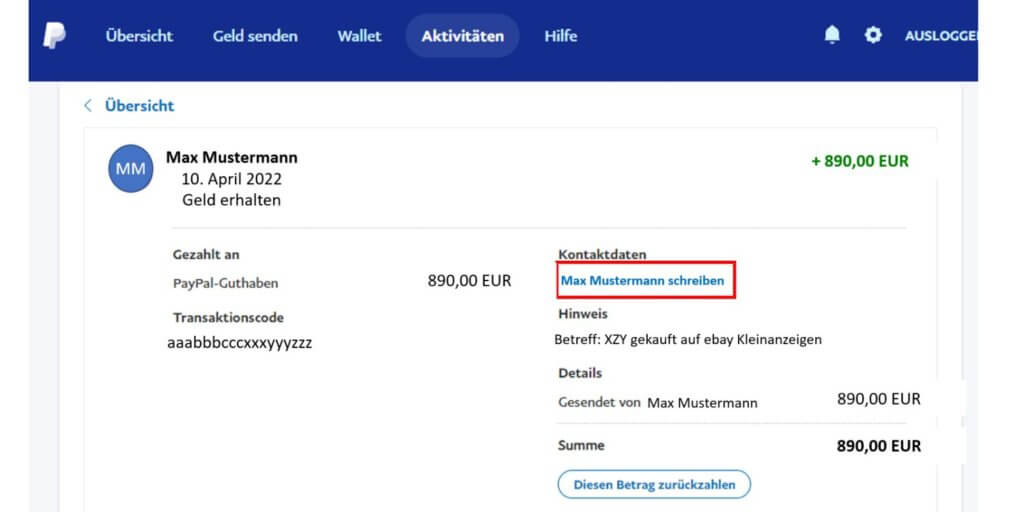
„Dear Buyer, Thank you for your payment via PayPal. Just to be sure: On Ebay Kleinanzeigen you told me to send the purchased item XYZ to this address: Günter Gauner, Schummel Straße in Musterstadt. On PayPal, I now see your name is Max Mustermann. Is the address from Ebay Kleinanzeigen correct?“
Payment Received via Bank Transfer:
You received payment via bank transfer and are suspicious? Then contact the supposed buyer again via Ebay Kleinanzeigen and ask control questions such as the purpose of payment, transaction code, date of transfer, bank name, etc.
If your "buyer" cannot or will not answer these questions, the transfer probably did not come from them.
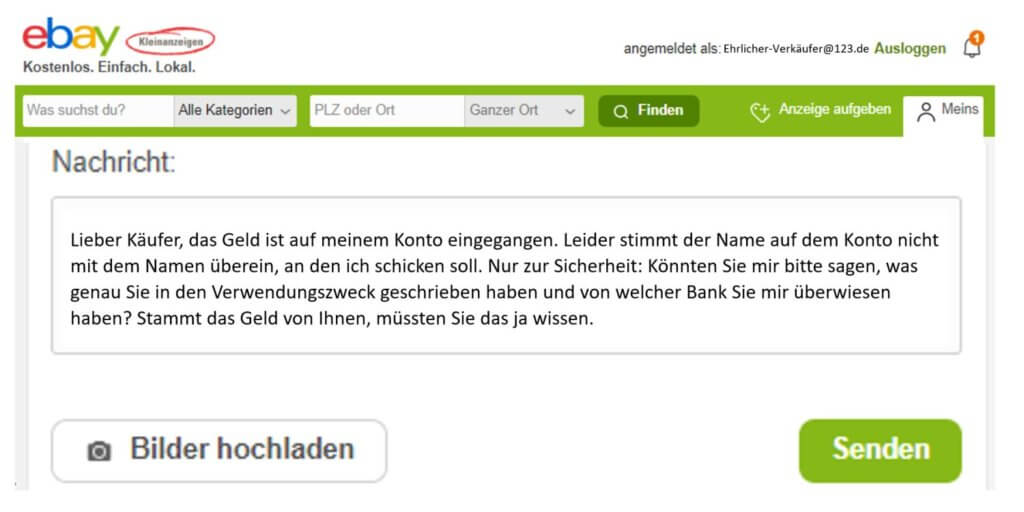
You can also ask the supposed buyer to send you a screenshot of the transfer or a receipt. Only if they transferred it themselves can they do this.
In general: If the name (and address) you are supposed to send to does not match the name of the account holder from whom the money comes, be sure to ask and pose control questions. In case of doubt, wait and do not send any goods. Since in most cases the honest seller is the victim of triangulation fraud, they should be a little more cautious.
How an Honest Buyer Can Identify a Triangulation Fraudster:
It is significantly harder for a buyer to recognize triangulation fraud in time. Most offers from triangulation fraudsters resemble those of fake offers. The user's account is relatively new, and there are probably few to no reviews. The main differences: The triangulation fraudster's offer is realistic. They do not sell significantly below value, and the triangulation fraudster will immediately accept bank transfers or PayPal with buyer protection (depending on what the honest seller has offered them in terms of account details and payment options). And since you are protected by PayPal through buyer protection, a purchase initially carries no risk for the honest buyer.
As an honest buyer, you should become genuinely suspicious if the seller (fraudster) eventually asks you for the exact wording of the payment reference or the transaction code of the transfer. After all, the seller should be able to find the data in their own account. If you, as an honest buyer, are asked these questions, the triangulation fraudster has probably come across an attentive, honest seller who has asked them some control questions, as recommended here. In that case, please do not respond.
General Tips to Protect Against Further Scams
Of course, the three schemes presented are by no means all that fraudsters have up their sleeves these days. Therefore, below you will find some general tips and advice to help you avoid being scammed.
- Always communicate with the buyer/seller on Kleinanzeigen. Do not switch to email, SMS, WhatsApp, or other messenger services. If you have done so by mistake, never respond to PINs, TAN codes, or links that you receive from a potential buyer on Kleinanzeigen through these channels (e.g., via SMS). If you do, you may be paying an open bill for someone else using these PINs, and the amount will be charged through your mobile phone provider.
- As a buyer, decide for yourself how you want to pay. Stay away from payment models you are not familiar with. Paysafecards and fake letters from Deutsche Post are also currently a popular trick to swindle unsuspecting buyers out of their money. However, this trick only works if you communicate via email, WhatsApp, SMS, or similar.
- If the seller insists that you pay cash on delivery, always open the package in the presence of the postman. Sending "empty" packages when paying cash on delivery is also a popular trick. The parcel delivery person will see that you have received an empty package and will then be your witness.
- If links are provided in Ebay Kleinanzeigen ads, be suspicious. If this link leads you, for example, to a page where data is requested via a form, or where you are supposed to pay, do not disclose any data here.
- If you are able to pick up the goods in person, insist on cash payment on site.
What you can do if you have been scammed on Ebay Kleinanzeigen:
And if it does happen: Go to the police and file a report, even if the chances of getting your money or goods back are slim. While you can report the case to Ebay Kleinanzeigen, don't expect any help there.
Paypal will only help you in case of fraud if you used the goods or services option. If you wanted to save on fees and used the free Paypal friends, Paypal will not help you, even if Paypal could. In this case, only authorities such as the police can force help and cooperation (such as data inspection). However, it is usually too late by then, and the scammer's corresponding Paypal account is already empty.
Conclusion
With fake offers, the pickup trick, and triangle fraud, we have shown you three ways scammers are currently making a profit on Ebay Kleinanzeigen. Unfortunately, scammers are becoming increasingly creative, and new tricks and schemes are sure to follow soon. Common sense is not always enough to reliably detect scams. Trust your gut feeling: if something seems suspicious to you, it probably is. If you have a strange feeling, stay away from the purchase/sale. So always be vigilant and make it as difficult and unattractive as possible for scammers. Then one day they might just stop on their own...


